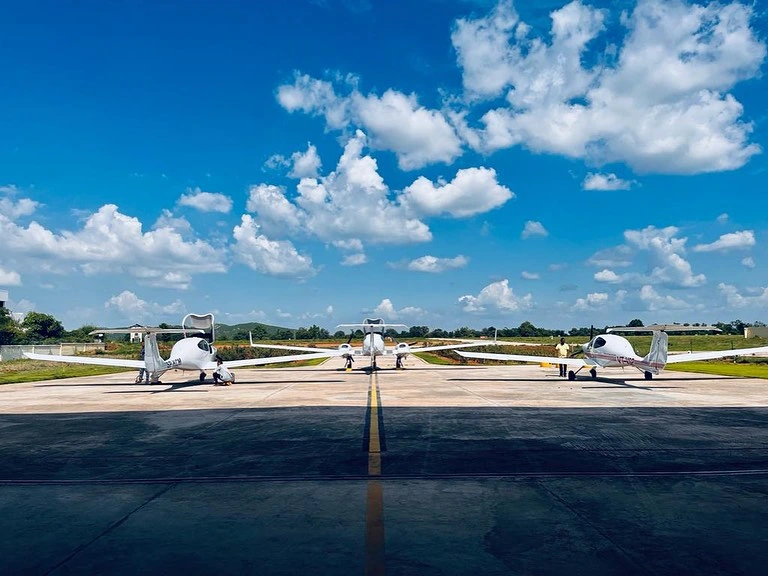
What makes CPL training at Indian Flying Academy different?
Indian Flying Academy reports an average of approximately 250 flying hours per DA40 per month—approximately 1,000 monthly hours across its four single-engine Diamond DA40 aircraft, a Diamond DA42 for multi-engine training, Garmin G1000 cockpits and a deliberately controlled student intake. Based at Khajuraho Airport, Madhya Pradesh, IFA brings together flying capacity and an established airport environment with ATC, instrument navigation aids and lighting infrastructure.
For an aspiring commercial pilot, that combination addresses a fundamental question: will your academy have the capacity, aircraft and operating environment to keep your training moving?
At IFA, we believe the standard should be set by what the training operation delivers every month. Our focus is a functioning ecosystem: aircraft that fly, admissions aligned with capacity, and lessons that build the habits of a professional pilot.
An average of 250 flying hours per DA40, every month
An aircraft count tells you how many aircraft an academy has. Flying output tells you something more useful about how that fleet is being used.
IFA reports an average of approximately 1,000 flying hours per month from its four DA40s. That equates to approximately 250 hours per single-engine aircraft per month, calculated across the fleet.
That output reflects an operation in which aircraft, instructors, maintenance planning and airport access work together. At IFA, capacity is something we put to use, month after month.
Our focus is sustained delivery: keeping the fleet productive and matching the training pipeline to the resources behind it. That is the system our cadets join.
At IFA, flying capacity is central to the admissions conversation.
The 1,000-hour figure is an academy-reported fleet average, not an allocation to each cadet or a promise that every month will be identical. Individual progress depends on readiness, performance, weather, serviceability and operating conditions. Our training team plans individual progression within that wider flying programme.
Why controlled admissions matter as much as fleet size
A growing academy can add students faster than it adds usable flying capacity. When that happens, a large fleet can still leave cadets competing for limited slots.
IFA’s approach is to control intake so that the training pipeline remains aligned with the operation’s capacity. We do not want admissions growth to overwhelm the ecosystem students joined us for.
That means looking at the relationship between active cadets, aircraft availability, instructor capacity and the training stages already in progress. Students approaching solo, cross-country flying and multi-engine training have different requirements; intake planning needs to account for those differences.
Our principle is straightforward: admit with the capacity to train.
Every intake decision must serve that goal. We protect the training environment by managing the number of students entering it, rather than allowing the pipeline to become overcrowded.
What is a good student-to-aircraft ratio for CPL training?
A useful ratio compares active flying students with serviceable training aircraft, alongside instructor availability and actual monthly output. Total enrolments divided by total registered aircraft can hide important differences.
At IFA, controlled batch sizes and disciplined intake protect access to the fleet. We consider aircraft availability, instructor capacity and cadet training stages together, so new admissions support a functioning pipeline.
Khajuraho: commercial-airport infrastructure without the congestion
A fully equipped airport does not have to be a busy airport. At Khajuraho, that distinction works in IFA’s favour.
Our base combines an Airports Authority of India airport, a 2,286-metre runway, ATC and instrument navigation and lighting infrastructure with a light scheduled airline presence. [1]
With approximately one to two scheduled airline flights a day, Khajuraho gives IFA the benefits of a commercial airport without the sustained airline traffic of a busy hub. These limited movements fit into our training operation without materially impeding the flying capacity we deliver.
For IFA, this is a practical operating advantage. Our cadets work with ATC and experience a professional airport environment while our flying programme retains room to operate. Airline exposure and productive training coexist here.
ILS. VOR. Approach lighting. Night-flying infrastructure. Real ATC. Room to fly.
That combination supports our academy-reported average of approximately 250 flying hours per DA40 per month across four single-engine aircraft. Infrastructure gives the programme depth; a low-congestion airport helps us put that infrastructure to work.
Our one-to-two-flight description reflects IFA’s assessment of the scheduled airline environment in October 2026; it is not a count of all aircraft movements. Airline timetables may change. [2]
ILS, VOR and approach lighting: why the airport’s equipment matters
Instrument training becomes more tangible when the equipment discussed in a briefing is part of the airport environment around you.
Published AAI information for Khajuraho lists ILS components for Runway 19, DVOR/DME, NDB, approach lighting, PAPI and runway and taxiway lighting. [1] These facilities provide context for learning about navigation, approach guidance and the transition between instrument references and visual cues.
| Feature | What it helps cadets understand |
|---|---|
| Instrument Landing System — ILS | The relationship between lateral and vertical approach guidance |
| VOR/DME | Radio navigation concepts, position awareness and distance information |
| Approach Lighting System — ALS | The role of visual references during an approach |
| PAPI | Visual approach-path information |
| Runway and taxiway lighting | The visual environment for ground movement and flying after dark |
| ATC | Clearances, radio discipline and coordination with other traffic |
The educational value comes from connecting the briefing, cockpit indications and outside environment. Facility availability and the training exercises conducted depend on current aeronautical information, serviceability, permissions and the approved training programme.
Night flying adds another dimension to pilot development
Night flying changes the visual environment. Familiar terrain looks different, outside cues reduce, and preparation, instrument awareness and judgement take on a different emphasis.
For IFA cadets, night flying is part of the training proposition at Khajuraho. The airport’s lighting infrastructure provides an important foundation; lessons are planned within applicable approvals, operating arrangements, conditions and student readiness.
This broadens the experience beyond daytime handling. It helps cadets appreciate why disciplined preparation and a structured cockpit routine remain essential when the view outside changes.
Our team coordinates night training within the airport’s available operating arrangements, making it part of a structured progression.
The Diamond flying edge: modern aircraft with professional relevance
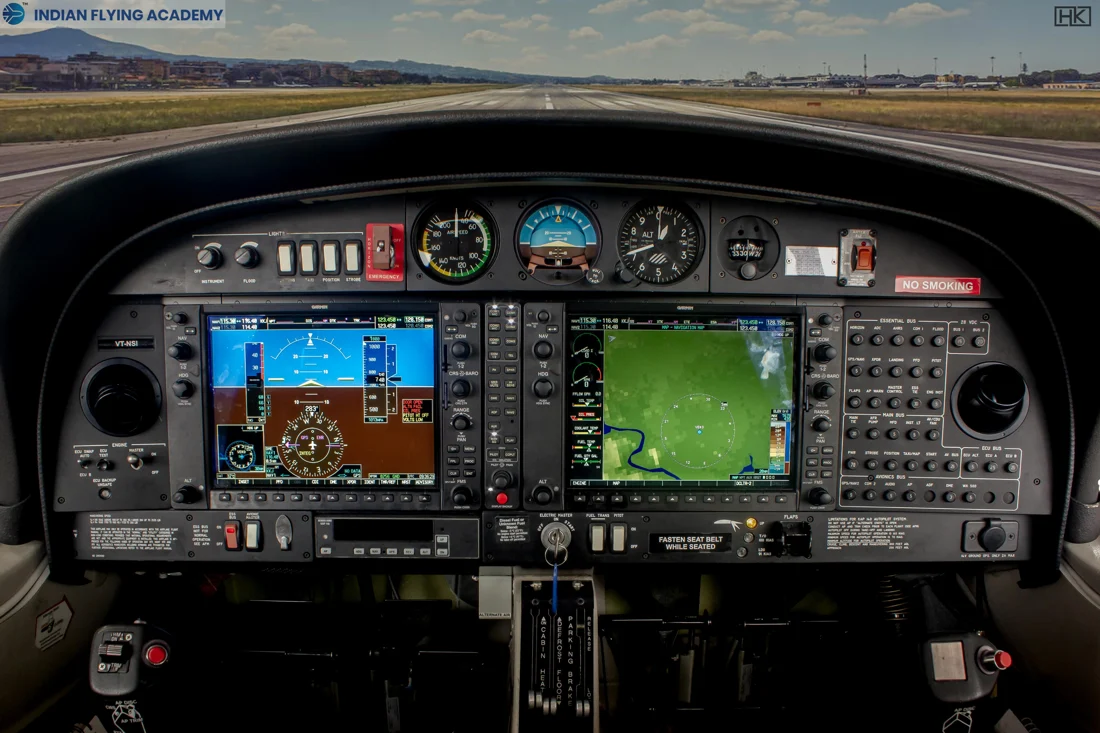
IFA operates four Diamond DA40s and one Diamond DA42, with Garmin G1000 avionics across the training fleet.
The advantage is a coherent learning environment. Students develop their single-engine foundations in the DA40 before progressing to multi-engine training in the DA42. Familiarity with the avionics philosophy can support that transition, while the handling, systems and procedures of the twin still require dedicated instruction.
The DA40’s canopy and cockpit layout are also part of the experience. Visibility supports observation outside; the glass cockpit brings flight and navigation information into a display-based environment that cadets learn to interpret thoughtfully.
At IFA, Diamond DA40 training brings these elements together: outside awareness, disciplined instrument scanning, accurate navigation and effective workload management.
Explore why IFA chooses Diamond for CPL training.
How FADEC supports the training experience
FADEC means Full Authority Digital Engine Control. On the diesel DA40 configuration described by Diamond, electronic engine management coordinates functions including fuel injection and propeller adjustment, with single-lever power control. [3]
That simplifies aspects of manual engine-control workload and creates a useful opportunity to focus instruction on flight-path management, navigation and awareness. It also introduces an important professional responsibility: understanding what an automated system does, monitoring it properly and following the aircraft’s procedures.
Automation belongs alongside strong fundamentals. The aim is a cadet who can manage the aircraft thoughtfully and understand the systems supporting the flight.
DA40 engine and avionics configurations vary. Prospective students should review the actual aircraft and configuration they will fly rather than assume every DA40 shares identical equipment or performance.
Early RT confidence, with an airline career in view
Radio telephony is an everyday operating skill at a controlled airport. At IFA, developing clear, accurate RT early in training is a priority.
Repeated supervised exposure helps cadets learn to listen carefully, identify relevant instructions, make appropriate read-backs and communicate with composure. Those habits matter as the workload grows and the flying becomes more demanding.
The same principle extends across the training experience: preparation before the flight, orderly procedures in the cockpit, awareness during ground movement and an honest debrief afterwards.
Your airline ambition should influence the habits you build from the beginning.
CPL training establishes foundations for that journey. Airline selection, further training and aircraft-specific qualifications are subsequent stages; airport exposure alone does not confer airline readiness.
Read how IFA’s controlled-airport environment builds professional habits.
A training ecosystem designed around the cadet’s progress
The fleet and airport matter most when they work together with the rest of a cadet’s experience.
IFA’s CPL pathway targets 200 flying hours, including 15 hours of multi-engine training. The current quoted programme fee is ₹59.5 lakh, with a planned training duration of 12 months subject to readiness and performance. Weather, serviceability and airport operations also affect scheduling.
Optional accommodation offers single-occupancy AC rooms and three meals at ₹20,000 per month. For cadets relocating to Khajuraho, that provides a practical base around which to organise their training routine.
For those planning further ahead, the IFA × Avion integrated CPL and Airbus A320 type-rating pathway is currently offered at ₹76.5 lakh, with a planned duration of 16 months. Admissions can explain the current scope and payment arrangements for the relevant pathway.
The objective remains consistent: build an environment in which cadets can concentrate on training, understand their next milestone and progress through a manageable pipeline.
The IFA model: capacity, capability and controlled intake
IFA’s advantage comes from the way the parts work together.
| The IFA model | What it brings to our training operation |
|---|---|
| An average of approximately 250 hours per DA40 per month | Productive single-engine flying capacity |
| Controlled admissions | A pipeline aligned with aircraft and instructor resources |
| Four DA40s and one DA42 | A Diamond pathway from single-engine to multi-engine training |
| Garmin G1000 cockpits | A consistent avionics environment across the fleet |
| Khajuraho’s instrument and lighting infrastructure | Depth in the training environment |
| Approximately one to two scheduled airline flights daily | Commercial-airport exposure with limited airline congestion |
A higher standard of training starts with a system designed to deliver it. At IFA, that system is built around progress.
Frequently asked questions
How many hours does Indian Flying Academy fly each month?
IFA reports an average of approximately 1,000 monthly flying hours across its four single-engine DA40s. This is a fleet-level operating figure, not a per-student allocation. Individual flying is planned within the academy’s wider training programme.
Which aircraft does IFA use for CPL training?
IFA’s fleet comprises four Diamond DA40 single-engine aircraft and one Diamond DA42 multi-engine aircraft, equipped with Garmin G1000 avionics.
Where is Indian Flying Academy based?
IFA is based at Khajuraho Airport in Madhya Pradesh, India, an AAI-operated airport with ATC and a 2,286-metre runway. [1]
Does Khajuraho Airport have ILS and VOR facilities?
AAI’s published aerodrome information lists ILS components for Runway 19 and DVOR/DME, alongside other aids. Current availability and training use must be checked against applicable aeronautical information and operating arrangements. [1]
Is night flying available at IFA?
IFA includes night flying in its training proposition at Khajuraho, subject to the approved programme, student readiness, available operating hours and applicable conditions. Discuss the planned night-training arrangements with admissions.
Why does student-to-aircraft ratio matter?
It helps indicate how many cadets share the fleet. A meaningful assessment also includes serviceable aircraft, instructor availability, training stages and recent flying output. IFA deliberately controls intake to keep admissions aligned with capacity.
Can I complete CPL training in 12 months at IFA?
IFA’s planned training duration is 12 months subject to readiness and performance. It is a target; weather, aircraft serviceability and operating conditions can also affect progress. The academy’s monthly output does not guarantee an individual completion date.
How much does CPL training at IFA cost?
The current quoted CPL programme fee is ₹59.5 lakh, including 15 multi-engine hours within the 200-hour flying pathway. Optional accommodation is ₹20,000 per month. Request the current written cost breakdown for full inclusions and additional expenses.
See the fleet. Understand the capacity. Choose your next step.
Before committing to a flying academy, look closely at the system behind its promises.
At Indian Flying Academy, that means four DA40s, a DA42, an academy-reported average of approximately 1,000 monthly single-engine flying hours and an intake policy intended to protect the training experience.
Come to Khajuraho. See the aircraft, understand the airport environment and ask how your training will be planned.
Your ambition deserves an academy built around progress.
Explore IFA’s CPL programme and speak with admissions.
Sources & further reading
Airport and aircraft references, with IFA operating figures attributed to academy management. Airport facilities are described from a dated AAI archive, not a live operational bulletin.
- AAI — Khajuraho aerodrome information, 6 August 2026 archive ↗
- Air India — Khajuraho winter network additions from 25 October 2026 ↗
- Diamond Aircraft — DA40 TDI, Garmin G1000 and FADEC technical background ↗
- IFA management, October 2026: operating average, fleet, controlled admissions and programme information. The monthly figure is academy-reported, not an independently audited industry benchmark.

Pilot training at Khajuraho Airport, Madhya Pradesh.
Explore the academy ↗